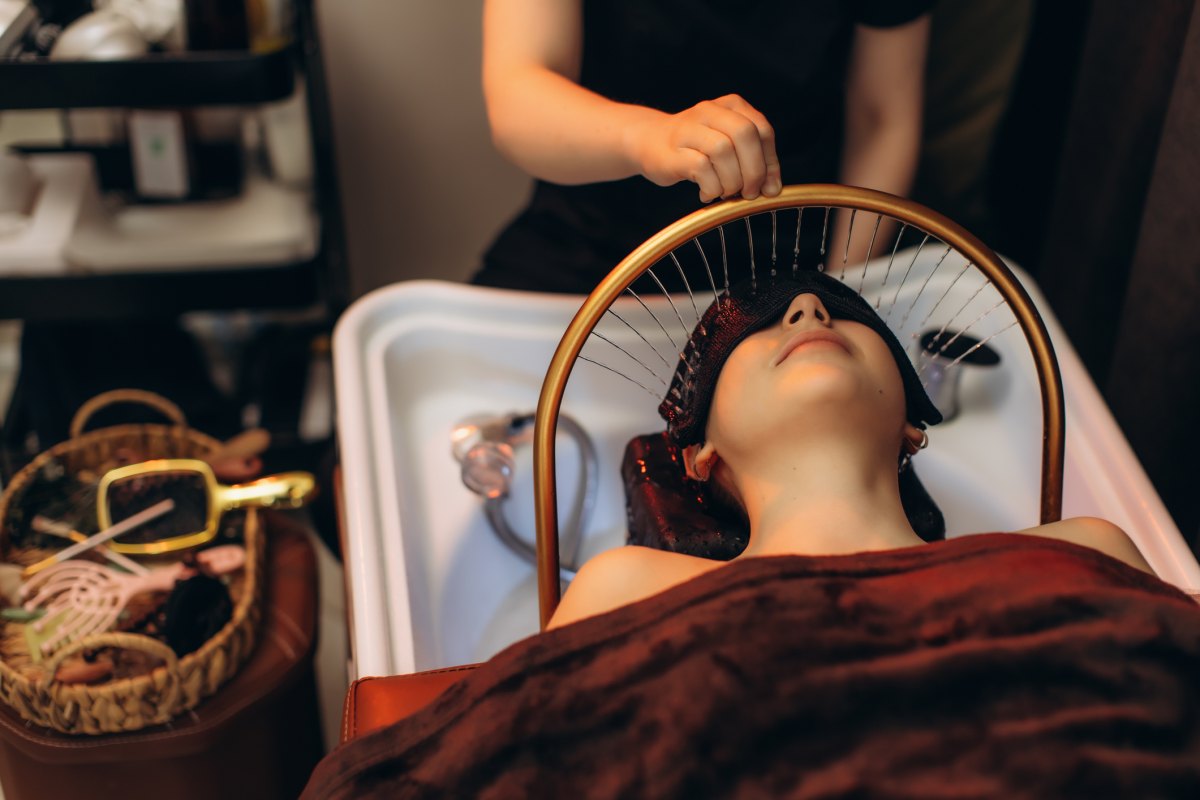


The Japanese head spa has officially taken over your For You Page — and now it’s taking over U.S. salon booking waitlists too. The 90-minute treatment that went viral for its ASMR-coded scalp massage clips, gurgling water and impossibly satisfying foam lather is no longer just content to watch. People are actually booking it, and spots are filling up fast. Here’s everything you need to know before you do.
What Is a Japanese Head Spa?
It’s a 60 to 90 minute scalp and hair treatment that typically combines a scalp inspection, deep cleansing, exfoliation, steam and an extended head, face and neck massage. Essential oils, conditioning masks, aromatherapy, dimmed lights and soft music are standard.
The ritual took off in Japanese salons in the 1990s before spreading across Asia and the U.S. The global scalp care market is projected to grow significantly over the next decade, driven by hair loss, stress, pollution and aging, according to Forbes. The viral 2022 social media moment, with its low light, gurgling water, foaming lather and rhythmic scalp massage, hit just as ASMR content exploded.
What Happens During a Japanese Head Spa Session?
Each session opens with a quiet consultation, followed by a microscopic scalp analysis that checks hair thickness, follicle production, blood flow and signs of dandruff, clogged pores or product buildup.
What comes next depends on what the analysis finds. “If your scalp is dry, we use oils, heat and steam to provide intensive skin care,” Nina Baxmann, a Japanese head spa owner in Germany, told MindFood. Heat and steam open the cuticles so products absorb deeper, and sebum plugs or product residue get worked out with scalp exfoliation using fine sea salt crystals. Traditional ingredients include camellia (tsubaki) oil and rice water. Trichologist Penny James told Byrdie the techniques “target and lift the scalp muscles to stimulate blood flow to the scalp.”
What Are the Benefits of a Japanese Head Spa?
Head spas cleanse the scalp, stimulate blood flow, strengthen hair follicles and lower stress and anxiety. Increased blood flow can also help with hair regrowth.
The real draw for many clients is simply where the massage lands. “Typically, when you go get a massage, the focus is always like your back, and I always wish there was more on my head, on my face especially, on my neck. When I saw that they give 90 minutes of just head, face, shoulder massage, I felt like it’s a great way to just focus on the areas that I love,” Karena Kong, a customer at Nen Head Spa in San Francisco, told AP News.
Can a Japanese Head Spa Help with Hair Loss?
A head spa can complement medical care for hair loss, but it isn’t a substitute. Treatments aimed at thinning hair rely on products and massage designed to boost circulation at the roots.


Anyone losing hair should still see a specialist. “It’s important to know and differentiate something that’s done for a health reason or relaxation from seeing a medical expert, a dermatologist, if you are having hair loss,” Zakia Rahman, a dermatology professor at Stanford University School of Medicine, told AP News. Rahman said head spas are generally fine as a complement to actual medical treatments and for people who simply enjoy them.
How Often Should You Get a Japanese Head Spa?
In Japan, head spa visits aren’t one-and-done. Experts recommend going about once a month and treating the appointment as reinforcement of a daily routine rather than a quick fix.
Shoji Sugimoto, founder of Yolu Beauty Salon, told Who What Wear that cadence matters less than consistency at home. “One might think of it as a facial. In Japan, the visit is only the beginning. Lasting results come from consistency. More than 81% of people in Japan wash their hair every night, so scalp care is already a daily reset before sleep. That nightly rhythm matters more than how often you book,” Sugimoto said.