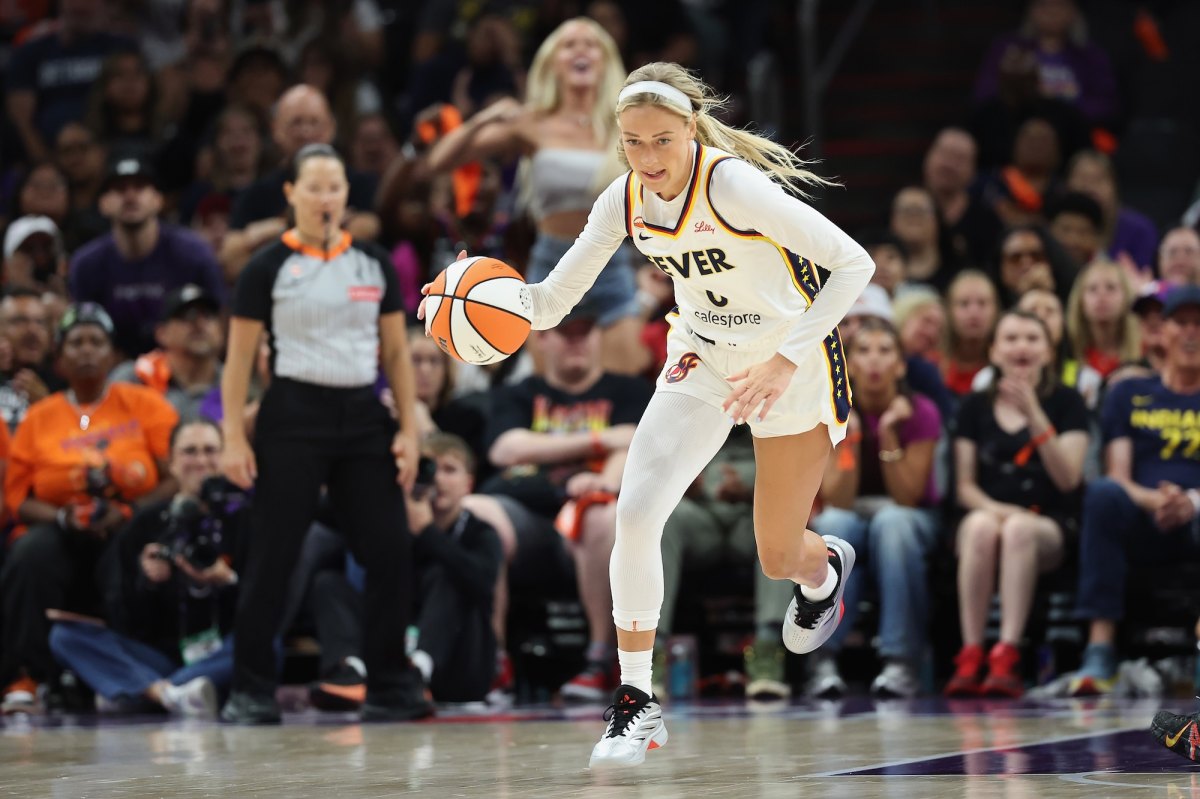

Indiana Fever guard Sophie Cunningham isn’t backing down from her stance that trans women don’t belong in women’s sports.
“I said what I said,” Cunningham, 29, told reporters at a Fever practice on Wednesday, July 22. “I think it’s kind of common sense. I think I’ll always believe in that. I think it’s really important to protect children.”
She continued, “I’m not a very political person but I do have beliefs. I have morals and I’ll always stand on those and be true to who I am. People are going to take it how they want to take it, but I never really said anything about that. When it comes to protecting young girls in sport and women in sport, I feel very strongly about that.”
Cunningham’s comments came after ESPN published a feature with her in which she defended what she called her “very much in the middle” political beliefs, despite some fans giving her the nickname, MAGA Barbie.

“I got a lot of negative feedback about me hating trans. And I’m like, ‘I never once said that,’” she said in the story published Tuesday, July 21. “I think that I am here to extend love. But I also think, with that, love is truth, being honest. And I want to protect young girls in a locker room, or young girls in sport who shouldn’t have to go against biological men.”
The debate over trans people in sports is nuanced and, despite it affecting a miniscule portion of the population, has become a hot-button political issue with 745 related bills introduced in state legislatures across the country in 2025, according to San Francisco’s Office of Transgender Initiatives. That is despite no conclusive evidence that trans women have a competitive advantage over cis-gendered women in sports.
A 2024 study funded in part by the IOC and published in the British Journal of Sports Medicine even found several disadvantages that trans women may face, including poorer lower-body strength and lung function compared to cis-gendered women.
Additionally, Dr. Joshua Safer, Executive Director of the Mount Sinai Center for Transgender Medicine and Surgery in New York, insisted, according to the ACLU, that a person’s “genetic makeup” and “external reproductive anatomy” are not useful indicators of athletic performance.

“There is no inherent reason why [a trans woman’s] physiological characteristics related to athletic performance should be treated differently from the physiological characteristics of a non-transgender woman,” he said.



Despite her controversial stance, Cunningham insisted on Wednesday that she doesn’t “dislike anyone.”
“I think there is room for absolutely everyone here and I think there’s room to love everyone,” she said. “I truly think when you get people in the same room and have conversations, you have a lot in common with a lot of people. I’m there to love, but I’m also there to love biological women and I think there are rights that need to be protected.”
She added, “Whatever I say, I’m going to get hate and I’m going to get love. I beat to my own drum. People are always going to have something to say.”