
Walk down any grocery aisle and you’ll see “natural flavor” on everything from seltzer to protein bars. Shoppers increasingly assume that phrase signals something healthier or purer than its artificial counterpart. The federal rules say something different, and the gap between what the label implies and what the regulation actually requires is quietly becoming one of the most consequential consumer trust questions in packaged food.
What’s Happening With Labels
The U.S. Food and Drug Administration defines “natural flavor” and “artificial flavor” in 21 CFR Part 101 Subpart B. Under 21 CFR 101.22(a)(3), a natural flavor is an essential oil, extract, distillate or similar product derived from a spice, fruit, vegetable, herb, meat, seafood, poultry, egg, dairy or fermentation product “whose significant function in food is flavoring rather than nutritional.” Artificial flavors, under 21 CFR 101.22(a)(1), are everything else that performs the same flavoring function.
The word “natural,” in federal terms, describes the source of the flavoring material, not how it was processed. Heating, enzymolysis and distillation all still qualify.
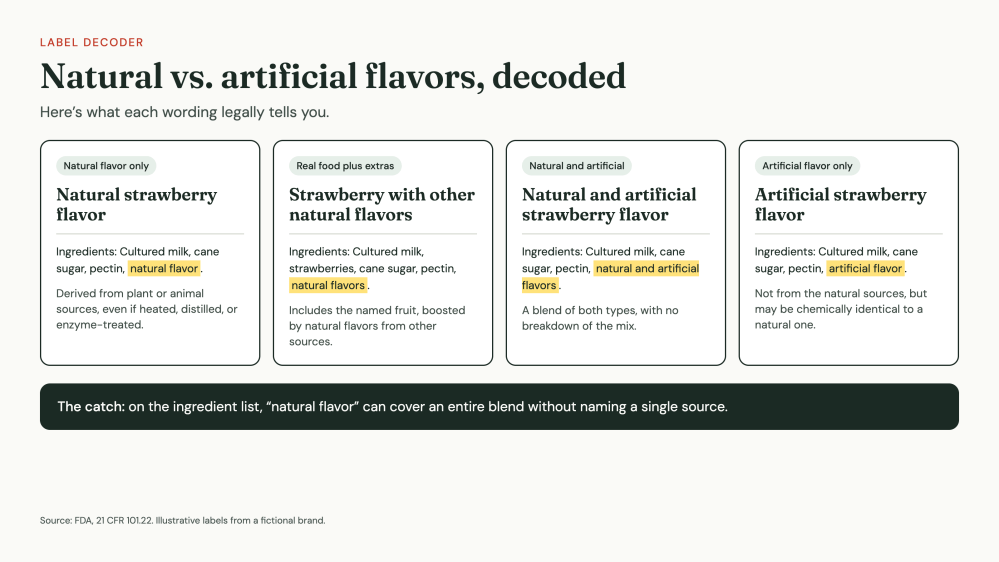
Labeling then follows a hierarchy most shoppers never learn to read.
- A pure natural flavor can be labeled “strawberry flavor” or “natural strawberry flavor.”
- A blend is labeled “natural and artificial strawberry flavor.”
- A fully synthetic version is “artificial strawberry flavor.”
- If the characterizing flavor comes partly from other natural sources, say real lemon boosted with lime-derived flavor, the label must read “natural lemon flavor, with other natural flavors.”
- If the characterizing flavor doesn’t come from the named food at all, the product must be labeled “artificially flavored” or disclose the actual source. That’s why “strawberry flavored” cereal can legally contain no strawberry.
Protein hydrolysates used for flavor are a narrow exception to vague labeling. They must appear by common name, which is why “hydrolyzed soy protein” is spelled out. Major allergens must still be declared even when they’re inside a flavor blend.
Why It’s Happening
Three forces are converging to put the “natural flavor” label under new pressure.
The definition is about origin, not purity. The American Council on Science and Health notes that two common consumer beliefs are not reliably true. One is that artificial flavors are inherently less healthy. The other is that a flavor chemical from a natural source is different from the same chemical made in a lab. The council points out that lab-made flavors are often close to 100 percent pure, while the plant-derived version typically is not.
What’s in the bottle isn’t just the flavor. Jennifer Allen, a food attorney at Zwillinger Wulkan, told Food Safety Tech that commercial natural flavors arrive packaged in solvents and functional additives, and those carriers are not required to be natural themselves.
Disclosure stops at the top allergens. Sources beyond the major allergens generally don’t have to be listed inside a flavor blend, which limits what even a careful shopper can learn from the ingredient panel.
“This may be why some consumers are skeptical about how ‘natural’ natural flavors really are.”
Jennifer Allen, food attorney, Zwillinger Wulkan
What Could Be Next in the Natural Flavor Conversation
Expect the “natural flavor” conversation to move from technical corners of food law into mainstream shopping behavior over the next several label cycles. Three scenarios are most plausible.
Scenario 1. Shopper scrutiny forces voluntary brand transparency. As more consumers understand that “natural” describes a source and not a solvent, brands competing on trust will start disclosing more than the regulation requires, naming carriers, confirming non-GMO flavor bases or dropping flavor blends entirely in favor of single-origin extracts.
What to do. When comparing two similar products, check whether either lists specifics beyond “natural flavor.” A brand that volunteers detail is signaling where the category is headed.
Scenario 2. Regulatory pressure builds on 21 CFR 101.22. The current rule has been durable, but the mismatch between its definition and consumer expectation is exactly the kind of gap that invites citizen petitions, state-level labeling bills and litigation. Watch for any federal guidance activity, as well as state attorneys general taking up “natural” claims as a consumer protection issue.
What to do. If you buy products marketed heavily on “natural” positioning, note the exact wording on the front of pack. “Natural flavor,” “naturally flavored” and “with natural flavors” each carry different regulatory weight, and future rulemaking is likely to target those differences.
Scenario 3. A new tier of claims displaces “natural.” Because “natural” is legally loose, brands chasing the premium shelf are already moving to phrases the regulation doesn’t define, like “clean label,” “no artificial anything” and “whole-food ingredients.” Expect that migration to accelerate, which means “natural flavor” could gradually become a mid-tier descriptor rather than a premium one.


What to do. Don’t pay a premium for “natural flavor” alone. If purity is the point of your purchase, look for products that name the flavor source directly, such as “made with real lemon juice,” rather than relying on the flavor-blend shorthand.
The clear takeaway is this. Treat “natural flavor” as a sourcing disclosure, not a health claim. The label tells you where the flavor came from. It does not tell you what else came with it, and it does not tell you whether it’s better for you than the artificial version.
THREE SIGNALS TO WATCH
1. Any federal guidance or proposed rulemaking touching 21 CFR 101.22, the specific regulation that defines both flavor categories.
2. Major packaged-food brands voluntarily disclosing flavor solvents and carriers on-pack, beyond what allergen rules require.
3. Growth of “clean label” and single-source flavor claims replacing generic “natural flavor” on premium SKUs.