In the mid-1980s, Mr. T was everywhere. He played Rocky Balboa’s fearsome rival, Clubber Lang, in the blockbuster Rocky III and starred as B.A. Baracus on NBC’s hit series The A-Team for four seasons. Kids played with Mr. T dolls and ate Mr. T cereal. He starred in WrestleMania 1 and 2 and guest-hosted Saturday Night Live and joined first lady Nancy Reagan in promoting her “Just Say No” antidrug campaign. His signature catchphrase — “I pity the fool” — became a defining quote of the decade. “I never [thought] about the effect I would have on people,” says the 74-year-old icon, born Laurence Tureaud. “It’s humbling.”
His image was unmistakable: a tough guy in combat boots, a mohawk and stacks of gold chains. But his real life story had many layers, explored in the new Netflix documentary Untold Mr. T: I Pity the Fool (debuting September 8). He and his 11 siblings grew up in a three-bedroom home on Chicago’s South Side, where his father, a minister, and devoted mother instilled in them the importance of faith and service to others. “We were poor financially, but rich spiritually,” he tells Us. He earned a football scholarship to Prairie View A&M University and made the honor roll before leaving school and later joining the Army.
He skyrocketed to fame after Rocky III but had little interest in the typical celebrity lifestyle, avoiding drugs, alcohol and the party scene. “I’ve seen people who lost their way when they came to Hollywood,” he says. Instead, he focused on using his power for good. When he landed a deal with Hanes, he asked the company for 1,000 pairs of socks to distribute to unhoused people. Licensing his doll, he says, gave him “the opportunity to take free toys to the kids in the ghetto.” Everything he did, Mr. T adds, “I worked it out so I could help people.”
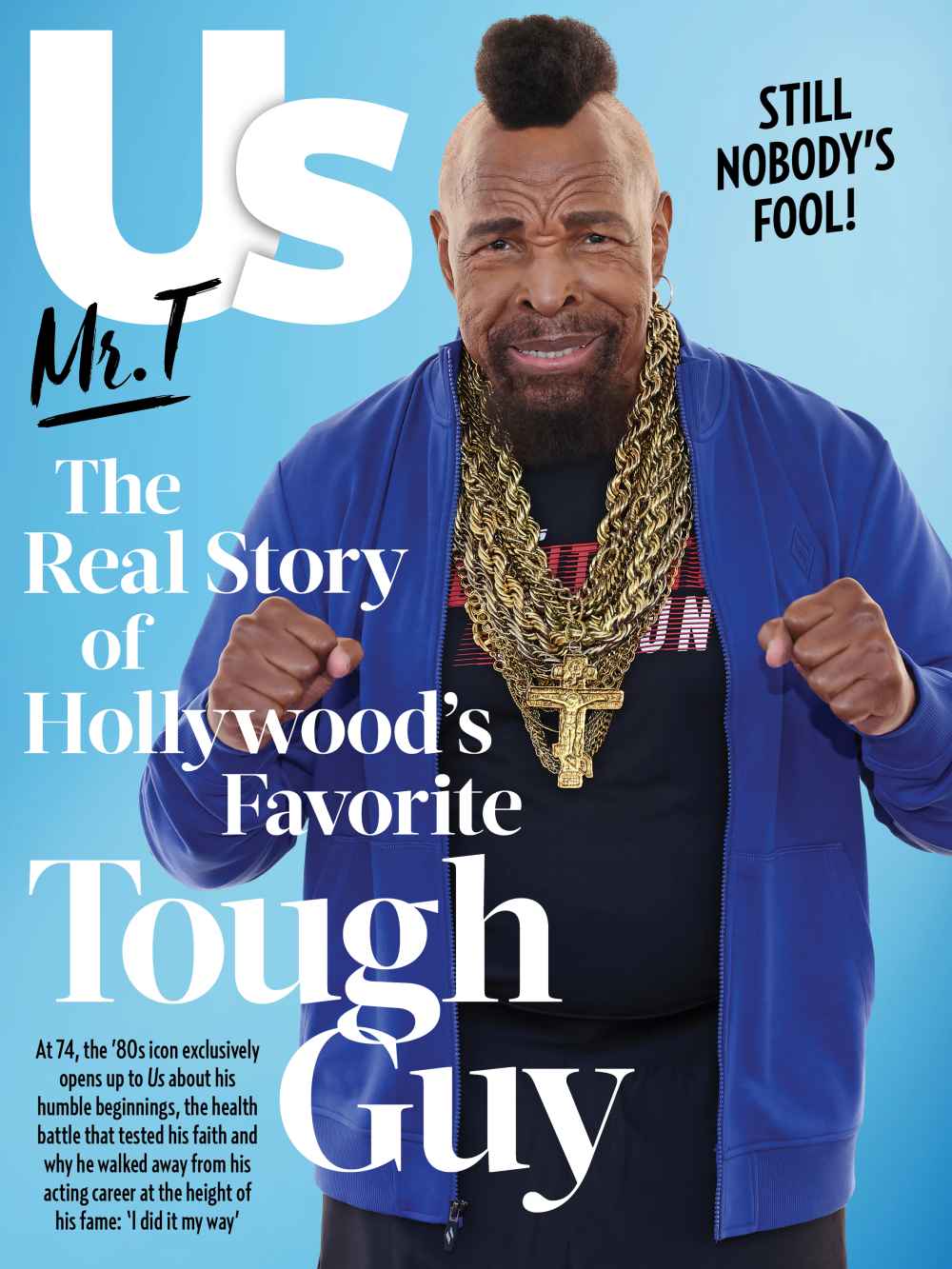
These days, the legendary star and father of three (he and ex Phyllis Clark are parents to Lesa and Laurence Jr. and comedian Erica Nicole Clark) is mostly living a quiet life back home in Chicago, making occasional appearances and doing ad campaigns for big brands like Skechers.
He talks to Us about surviving a battle with cancer, his bond with his Rocky director and costar Sylvester Stallone and how he came up with one of the most famous lines in pop culture history:
You faced a number of challenges growing up.
Mr. T: I was born and raised in the ghetto, but the ghetto was not born and raised in us. We went to church on Sunday. We loved our mother. We didn’t curse or hang in the gang. I used to throw rocks at condemned buildings and I [stole] candy bars, and I apologized to the owner [of the store] when I got older. We were called “sissies” because we wouldn’t hang out with the bad crowd. My brothers played football and boxed and wrestled, and a couple studied martial arts. We knew in the ghetto you had to be tough.

Did you know you were destined for something better?
Mr. T: My mother used to go to the suburbs and scrub white people’s floors. She was not allowed to look white people in the eye. But she never taught us hate. She said, “Son, if you want something, work hard and save your money and get it.” When I was 9… I told her, “Mama, one of these days I’m gonna be big and strong and I’m gonna buy you a beautiful house and pretty dresses.” [Then] acting came along and I bought my mother that house and the pretty dresses. It was hard, honest work. That’s what it’s about. That’s who I am.
You clearly had a very close relationship with your mom.
Mr. T: In Hollywood, they say, “Man, I love your car. I love them shoes.” How stupid is that? Love is a verb; it shows action. I can’t tell my mother I love her and not take care of her. My mother wasn’t just proud of me because I became so-called successful — she was proud because I didn’t forget her teachings. I never forgot about the less fortunate. She’s gone home to heaven, but she lives in my heart. I’m an old, tough mama’s boy.
You grew up with seven brothers and four sisters and your father was a minister. How did that shape you?
Mr. T: When [my parents] finally decided to get on welfare, my mother and father had to separate. My father was in-between jobs and they thought we were trying to scam the game. So he had to leave, and that brought out a little rage in me, and that is what drove me to say, “I’m gonna be a fighter and a football player” and while I’m training [I] can take out some of that rage.
Sports helped you?
Mr. T: Being tough on the football field prepared me for life. I always tell people, “If you make it in sports, you will make it in life.” The main goal is not to win a championship. It teaches discipline. It teaches you how to train, prepare yourself, and that’s what I did.
Fame brought some of your family disagreements into the public eye. [In 1984, one of Mr. T’s brothers sued him, alleging breach of an employment contract.] Have you all made peace since then?
Mr. T: We had the same arguments before I was famous. Nobody knew about it but now [that] I’m famous, stuff comes [out]. So if [I am] claiming to be a man of God, this is a test for me. That’s the test of who I am. So my brothers and sisters going through that, I’m gonna love them. They are hurting. Even while [there’s a] so-called problem with the family that [the public could] see, if somebody touches a member of the family, you see the whole family come together and bring hell on them. That’s an issue we’ll work out, and we have.

You changed your name to Mr. T at 18. Why?
Mr. T: Out of respect for my father. I watched him — a man of God, a minister — [be called] “boy” by white guys. They called my brother, who was a Marine, “boy” when he came back from Vietnam. I legally changed it so when people call me Mr. T, you’re respecting my father, my brothers and other black men. I always joke with people that for women and children, the T stands for tender, and for the bad guys and thugs, it stands for tough.
Do you think people had preconceived notions about you when you first became famous?
Mr. T: When I was invited to the White House in 1983 with Nancy Reagan, they did a background check on you. I smile when people check my background — they figure I was born in the projects, so I [must] have a record. But [I don’t]. That blew their minds. They couldn’t believe it. They said, “How did this happen?” It’s because we loved and respected our mother. That was my drive.
When did you first meet Sylvester Stallone?
Mr. T: I was [pro-boxer] Leon Spinks’ bodyguard. When Sylvester was writing Rocky and Rocky II, he would go to the fights. Leon lost the title in 1978 and [after the match] Sylvester came with his entourage and said he wanted to see the champ. I said, “I’m sorry, but he doesn’t want to see anybody right now.” I wasn’t disrespectful, but that was my job. When they called me to do Rocky III, my mind flashed back to when I didn’t let him in the dressing room. We talked about it later. He said, “You were a badass.” Some actors [might have said,] “Hey, man, you made me look bad,” but that wasn’t the case with him.

What was your audition for Rocky III like?
Mr. T: There were three parts to it. I had to box him for three minutes — a [real boxing] round is three minutes. That’s a long time. He was saying, “Come on, hit me.” I was like, “This guy doesn’t know I’ve knocked guys out at the disco [working as a bouncer]. If I hit him too hard, I might not get the part.” I was in a rough position. [When they cast me,] I said, “I’m gonna give you 150 percent every day.” Sylvester said, “I know you will, T.”
Tell us how the line “I pity the fool” came to be.
Mr. T: The scene seen in the movie when they said, “Clubber Lang, do you hate Balboa?” And I don’t hate anybody and I didn’t want to [say] that because [there’s] enough racism and hatred going around. So I changed the hate. I said, “No, I don’t hate Balboa, but I pity the fool.” People don’t realize pity means mercy.
Clubber Lang was menacing, yet audiences came to love you. How did you show them another side of yourself?
Mr. T: When we were filming The A-Team, we had a scene in Mexico where I fight this giant [guy]. I told the director, “I should lose this fight to get the fans,” because a lot of them were still frightened of me from Rocky. They wanted Rocky to win, and I was so mean, but I was playing a part. After I got beat, people were like, “Oh, we love him now.” The credit belongs to the kids because the kids fell in love with me, even though I was rugged. The parents were scared, but the kids said, “He looks tough, but he has a heart of gold.”
Have you and Sylvester stayed in touch?
Mr. T: [We were trying] to get him to do some stuff for the [Netflix] show. He was doing Tulsa King. I try to get messages to him to thank him for giving me an opportunity and allowing me to be me. Every once in a while I’d leave a message [with someone for him] and say, “Hey man, thanks again.”
Fans thought you and Hulk Hogan were close friends. What was your relationship like away from the cameras?
Mr. T: Truthfully, I wasn’t as tight [with him] as other people thought. We met on Rocky III. Then after Rocky III, I did WrestleMania. We were close together for about two weeks because we had to promote it. We did Saturday Night Live, [and] we did two episodes of The A-Team. We never called each other up. He never called me. I didn’t have his number. He didn’t have my number. We got together when there was a wrestling thing and they wanted us. We were tight in the ring. Other than that, that was it.
He had some controversies.
Mr. T: I was surprised to hear [about the racist remarks] myself because a lot of his fans [were] Black. I said, “I can’t explain it. He [has] to explain it.” I don’t want to say, “Maybe this happened [or] that happened.” He got in it, let him get out of it. As a Christian, I’m a forgiving man. God forgave me. [But] he never even explained it to me. He never brought it to me [and said], “Man, this is what happened.” He didn’t bring it, so that part I didn’t know.
There were reports of tension between you and George Peppard on The A-Team. What was really happening behind the scenes?
Mr. T: George was a little older actor. It was [an] adjustment. He had put in his contract that no other actor could make more than him, and I was making more than him, so they had to send my money around through my cartoon. You got to put everything [in] perspective. George [was] white. He had been around. He was hot at one time. Then he came to The A-Team, where Mr. T [was] the man. Some people weren’t used to this Black guy. I remember [a] magazine said [George] wanted press. [They told him], “If you want, we’ll put you and Mr. T on the cover, but we can’t give you a cover by yourself.” That hurt him. He [couldn’t] get away from this Black guy. [I was] making more money than [him], and [getting] all this popularity. I’m just minding my own business. I’m being true to the people. People can’t deal with that.
Did you feel that race played a role in how people reacted to your success on the show?
Mr. T: The third year of The A-Team, [NBC executive] Brandon Tartikoff [came] to [producer] Stephen Cannell and [said], “You know, Mr. T is beating up a lot of white people.” I thought I was just beating up crooks. That’s what the little kids saw: Mr. T [was] just beating up the crooks. Then [race came into it]: “Mr. T’s beating up white people.” I thought I was just beating up crooks. See how things change? I didn’t change. I’m just being me. People [were] loving on me. Some people can’t adjust to a Black man being in a position and saying something. People don’t like you because you paid the dues of discipline, because you’re doing what they can’t do [or] what they didn’t want to do.
Were you prepared for the level of success you achieved?
Mr. T: It’s really unbelievable. Here’s this kid from the ghetto who they said wouldn’t make it. Here’s the kid who did Rocky, who they said would be a flash in the pan. I didn’t get mad at the haters because that’s what haters do. Haters hate, runners run, actors act, players play.
Was it difficult to stay away from the party scene in Hollywood?
Mr. T: As a Christian, we are taught to understand that [drugs and alcohol are a] temptation and the devil wants to bring you down. I remember [someone saying,] “There’s a big party, a big rich guy got the yacht, and everybody’s gonna be there.” I said, “Will Jesus be there?” He said, “Oh, Mr. T, there you go again.” I don’t need to bump into somebody at the salad bowl hoping I get a new movie role. I don’t operate like that. So many people come to Hollywood and they go along to get along. I’m glad they see me as a square.

Your gold chains became legendary, but they carried a deeper meaning for you. What did they represent?
Mr. T: I wore the gold for three reasons. One, I wore the gold because when Jesus was born, three wise men came from the east. One brought frankincense, one brought myrrh [and] the other one brought gold. So gold was a gift to Jesus. The second reason I wore the gold: I could afford it. That’s the message I wanted to tell the people in the ghetto. I said, “It’s stupid for you to go out and buy gold and your rent [is] not paid. It’s stupid for you to go out and buy gold and your kids need a new pair of shoes or you need food in the pantry.” The third reason I wore the gold, the gold was symbolic of my African heritage. When my ancestors [were] brought from Africa, they were shackled by their neck, their wrists, their waist, in steel chains. So I turned those steel chains to gold to symbolize the fact I’m still a slave, only my price tag is higher.
How much did all that gold weigh?
Mr. T: It was 40 pounds. I used to carry the gold in a construction bag.
Why did you eventually stop wearing it?
Mr. T: I stopped wearing [the gold] when [Hurricane] Katrina hit, when New Orleans [was] flooded. When I saw people dying and all that, I felt that it would be a sin against God for me to wear my gold. I [gave] some of the gold away to help the people. The gold didn’t have that value [anymore]. People say, “What [about the] gold around your neck?” I say, “I don’t wear it around my neck. It’s in my heart because I feed the less fortunate.” I have a heart of gold, not [gold] around my neck.
Even your mismatched socks and combat boots had meaning. What was the story behind them?
Mr. T: When I was poor, we used to wear mismatched socks to school. A lot of kids who were [growing up in] the ’80s and the ’70s would have to wear mismatched socks, and other kids would laugh at them. So if I wore mismatched socks, it becomes a fashion. It becomes a fad. So now the poor kid, psychologically, he can go to school without the other kids laughing at him. The cool kids, [whose families] got [money], they want mismatched socks. They want to be cool like Mr. T. [Also], the boots I used to wear, they were handed down from my father to my brother. I said I would never stop wearing the boots till I finished my father’s journey. So when I bought my mother the mansion, I put my father’s boots by the door. I stopped wearing the boots.
You were diagnosed with cutaneous T-cell lymphoma in 1995. What was that journey like?
Mr. T: I said, “T, you’ve been fighting all your life. You fight racism. You fight jealousy. You fight hatred. This is another fight for you.” I tell kids or older people who get cancer, “We’ve got to be tough. Sometimes the medicine makes you throw up, but you will get past it, and you will get stronger.” My [faith] was tested. It’s easy for me to say I love God when everything is going well, but can I love God when I’m diagnosed with cancer? I had a $10 million mansion. My money couldn’t save me. My gold couldn’t save me. God saved me. My prayers saved me.
Did it change your perspective on life?
Mr. T: Eventually I’ll have to go. My mother had to go, my father had to go, some of my brothers had to go. That’s life. That’s the cycle we go through. But what are you doing while you’re here? That’s what it’s all about.
You visited children with cancer years before receiving your own diagnosis. How did those experiences help you face your illness?
Mr. T: I would see little kids. Some kids had cancer, and I would tell them, “God loves you. I love you. Don’t be afraid. Be tough.” So now I’m diagnosed with cancer. If I can’t call on that same God that I told them little kids to believe in, if I couldn’t call on that same God that I preached in pulpits about, that I told people about God, that meant I was a liar and I was a phony. I said, “God, give me strength to do Your will.” I remember when the little girls’ hair would fall out, and I would hug them and cry with them. [They would] say, “Thank you, Mr. T. I won’t quit now.” A doctor told me once, “Mr. T, I want you to know that visits from people like you sometimes mean more than the medicine. It helps the patients.” So that’s what I do.
You scaled back your acting career in the ’90s. Was that a conscious choice?
Mr. T: I was glad for the shift. I never dreamed of being an actor and all of this. After I did Rocky, I was ready to go back home. Then they stopped me and said, “Mr. T, this producer wants to meet you.” [For me], it’s not about constantly making money. I took care of my mother, and I wanted to spend time with her and sit on the rocking chair doing nothing. I wanted to go home and watch The Beverly Hillbillies — they were my TV heroes because they were rich, but they weren’t caught up like everybody else. My mother said, “Son, take time and smell the roses.” And I had a bunch of roses around our house, and I would smell the roses.
So no regrets about getting some distance?


Mr. T: If Hollywood said, “Hey, Mr. T, we’re tired of you,” I would say, “Thank you, Hollywood. I ain’t mad.” I don’t jump every time somebody waves some money. A lot of people get angry because they can’t make money off me. I don’t want to sound cocky or conceited, but if I never make another dollar, if I’m never on TV again, [it’s OK]. All I ever wanted to do in my life is done.
How are you using your platform today?
Mr. T: I [spend] time with the less fortunate, going places where [the] camera[s] don’t go, lifting spirits, trying to give somebody hope that’s on drugs because drugs [are] a sickness. [I tell] them, “Don’t give up. Get back with [your] family. Hey, man, you can [go to] rehab. Don’t quit.” Feeding the hungry, helping people — that’s what it is. Helping people.