
At 9:43 a.m. on April 21, 2016, the Carver County Sheriff’s Office received an unusual call. “We’re at Prince’s house,” a man named Andrew Kornfeld told the dispatcher as he frantically requested an ambulance to Paisley Park, the “Purple Rain” singer’s legendary estate in the Minneapolis suburb of Chanhassen. The day before, Prince’s team had reached out to addiction specialist Howard Kornfeld for help with the Grammy winner’s opioid dependency. Unable to travel from California, he sent his son Andrew, a 26-year-old pre-med student, in his place.
When Andrew entered the 65,000-square-foot home that morning, distraught staffers helplessly pointed him to Prince lying on his back on the ground near an elevator. “The person is dead,” Andrew stated in his 911 call before finally confirming, “It’s Prince.” Paramedics rushed to the scene, but the 57-year-old musician (born Prince Rogers Nelson) had already been dead for hours.
The news spread quickly, prompting wall-to-wall coverage. “I remember CNN cutting into its news programming with a report that someone had been found dead at Paisley Park,” Reach Media founder Michael Pagnotta, who counted Prince as his first PR client in the early 1990s, exclusively tells Us Weekly. “I don’t know why, but I instantly knew it was him.” Prince’s longtime lawyer L. Londell McMillan saw the alerts while working on the computer in his office. “My heart stopped, then skipped a beat,” he recalls.
“The 21st was a horrible day,” Prince’s ex-wife Mayte Garcia concurs. “I was driving. I got called, and I don’t know how I got home. I don’t know how many nos I said. It’s something that we are all going to have to deal with, losing somebody we love, but it was really hard, and I didn’t want it to be true.”

Ten years later, the hitmaker behind “When Doves Cry,” “Kiss” and “Raspberry Beret” lives on through his genre-defying music — but remains as much of an enigma in death as he was in life. “He could be a walking contradiction,” Pagnotta acknowledges, “expecting the most possible coverage while offering up the least to the media.” Indeed, Prince rarely granted interviews (“I’m so shy,” he warned Australian TV host Richard Wilkins in 2003), preferring to keep the focus on his art.
“He was fiercely protective of his image,” publicist Mitch Schneider, who represented Prince in the mid-’90s, tells Us. “I remember booking him on the Today show to perform. The program also, of course, wanted to interview him, but we told them up-front that this wouldn’t be possible. After his performance, [anchor] Bryant Gumbel made a beeline over to him to try and interview him, but Prince slyly ran off the set. Everything had to be on Prince’s terms.”
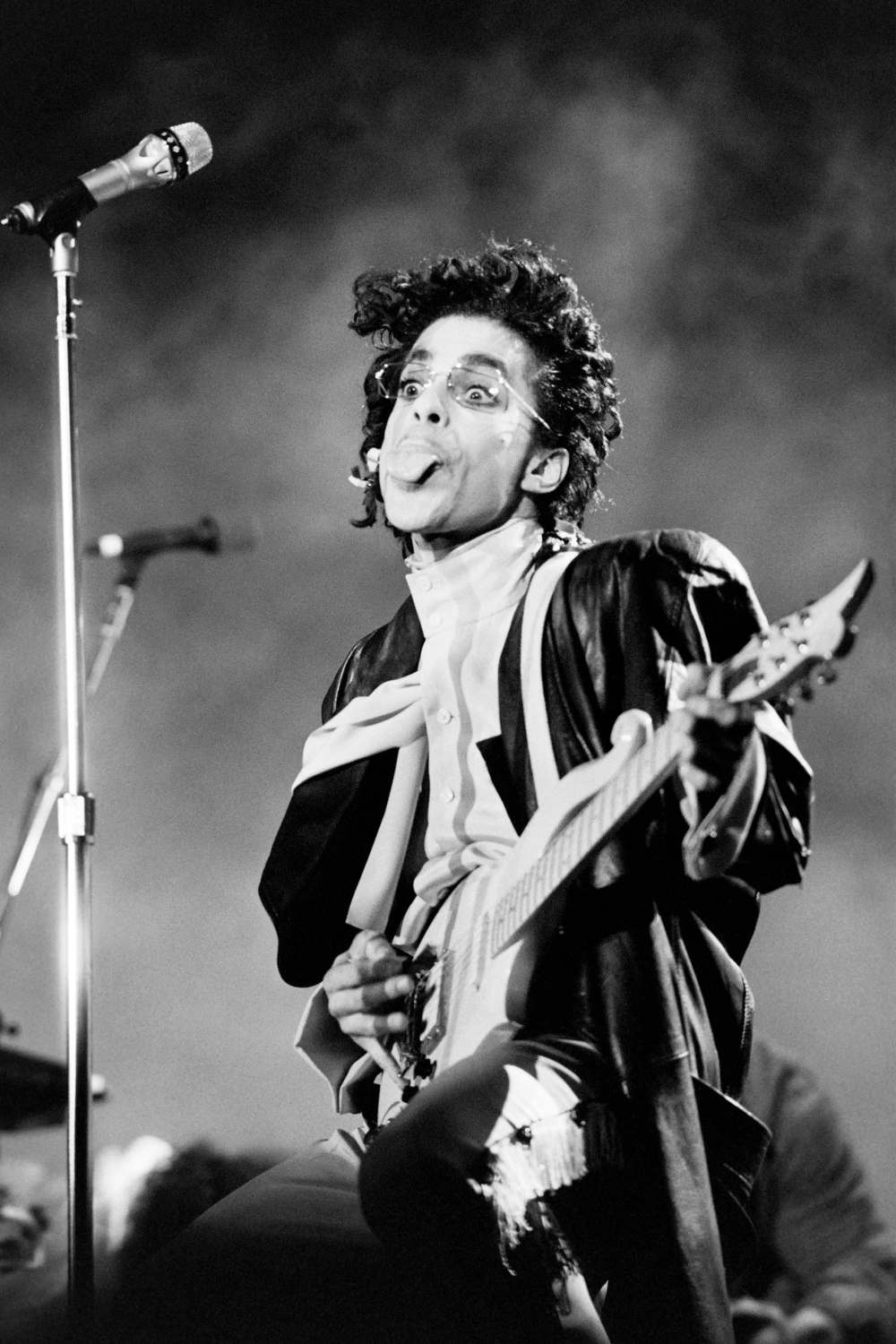
At times, The Purple One’s obsession with protecting his image could be exhausting for those around him. “He once said to me through that cagey smile of his, ‘When things go good, it’s because of me. When things go bad, it’s because of you,’” Pagnotta remembers, admitting that “working with him was terrifying.” But Prince’s one-of-a-kind temperament ultimately helped mold his team. “It was a very helpful, tough-love tip in growing my business and clientele,” Pagnotta adds.
Perhaps the most pivotal moment in Prince’s 45-year career came in 1993 when he briefly changed his stage name to a symbol in the midst of a contractual dispute with his label, Warner Bros. Records. “He phoned me up and asked, ‘How far are you willing to go?’” Schneider remembers. “I told him that I was his guy. His team gave me a computer disk with his famous unique symbol so we could promote his ‘name’ that way in our press releases. I have never worked with an artist before or since who had such an intense attention to detail.”

In his personal life, Prince was more relaxed. McMillan describes him as “funny and cool as hell,” sharing that their limousine rides on tour often turned into “long discussions about music, art, history, health and eating habits, community affairs and business plans.” Even after their four-year marriage ended in 2000, Garcia, 52, says the former couple never had any “bad energy” between them. “Once you got in the circle, he was very, very open,” she says. “I remember the conversations that we would have with so many people, and I’d just sit there like, ‘Wow, he’s not just a genius with his music but just so ahead of his time as well.’”

The Rock and Roll Hall of Famer treated those on his payroll like family. “He made everyone better and always brought out the best in you,” shares Ray Roberts, who worked as Prince’s personal chef for the final three years of his life after the singer visited his Minneapolis cafe, Peoples Organic. Soon, Prince’s eccentricities became the norm. “He loved the ‘corn on pizza’ that I made him and then repeatedly asked all his guests if they had had corn on pizza before,” says Roberts, who also owns Darling in the Seward neighborhood. “For weeks, he asked me to make that.” He was also a big coffee drinker. “It was always kind of a [running] joke of how many espressos he had,” the chef recounts, “so the band or those working with him would know how long the night was going to be.”

After all, there was a human behind the genius — one who was also shaped by profound loss. In 1996, Prince and Garcia welcomed their only child, a son named Amiir. Tragically, the infant — who’d been born with a rare genetic disorder known as Pfeiffer syndrome — died just days later. “We never talked children until we got married,” Garcia, who was a backup dancer for Prince and also sang in his New Power Generation band, tells Us. “He played this song ‘Let’s Have a Baby’ that he wrote for me. And it happened. He completely went 100 percent as a protective father. He went with [Amiir] to the NICU, and he didn’t leave his sight.” She believes the crippling loss ultimately led to their separation: “I don’t wish [that] on anybody. And I strongly think it was that.”
Today, Garcia, who adopted daughter Gia in 2013, finds comfort in knowing Prince never feared death. “I remember he used to always say, ‘I believe in spiritually growing and evolving.’ He was so into that, such a spiritual person. And he was like, ‘You guys need to celebrate,’” she recalls. “Now it’s like, ‘You’re right. We do need to celebrate you,’ because why are we gonna sit there in sadness? The world is sad enough. Let’s play his music and come together and do it for a cause.” (Garcia recently relaunched the exes’ nonprofit, Live 4 Love Charities, which they founded in 1996 in honor of Amiir.)

Following an extensive investigation, Prince’s cause of death was determined to be an accidental overdose of counterfeit, fentanyl-laced pills. Officials said the musician believed he had been taking prescription Vicodin to manage pain from hip and ankle injuries sustained over decades of high-energy performances. “He gave it his all every time he performed, and it’s not surprising that at some point he would need some relief,” Pagnotta reasons. “He was adamantly anti-drug, but I guess if a doctor prescribes it as medicine, it’s not drugs, right?”



Garcia knew her ex-husband had been dealing with health issues in his final years, but she wasn’t aware of the extent. “I heard he wasn’t feeling well, and then people were kind of talking, and for them to talk, it was like, ‘OK, I should maybe try and go see him,’” she shares. “He was a very private person, and to hear little things and for them to say that, it was like, ‘OK, this has got to be something a little more serious.’ But I had no idea it was that.”
In recent years, Prince’s estate has kept his memory alive by releasing previously unheard music from his famed vault, turning Paisley Park into a museum and hosting parties and events for fans at the complex, as he often did. (On the 10th anniversary of Prince’s death, fans lined up for tours of Paisley Park and its NPG Music Club, held a candle lighting and watched a screening of one of his 2014 concerts.) The estate has also been involved in several legal battles with his heirs, in addition to navigating how best to bring his story to the screen. Last year, Netflix shelved an already completed nine-hour documentary directed by Oscar winner Ezra Edelman due to alleged factual inaccuracies. In turn, the estate teased plans for its own film using footage from Prince’s archives. Meanwhile, Sinners director Ryan Coogler is producing a jukebox musical movie, though McMillan clarifies it is more of “an original story based upon Prince’s music” than a traditional biopic.
The projects will surely introduce Prince to an entirely new generation of fans. “If young people want to grow as musicians, they have his music and performances to watch and learn from,” says W&W Public Relations senior vice president Karen Lee, another one of the artist’s reps from the ’90s. Roberts agrees: “He was way ahead of his time. There are many musicians today that are following in his footsteps, blending genres and always reinventing themselves.” But, he adds, “There is no one like Prince.”