

If you have a garden or keep plants indoors, your dog could be at risk without you realizing it. Many of the most popular plants sold at garden centers and home improvement stores are toxic plants for dogs.
Several recent incidents have put the issue in the spotlight, from a Chihuahua who needed emergency surgery to a springer spaniel who died hours after visiting a tulip festival. Now, pet owners and industry experts are calling for warning labels on plants sold to consumers.
Knowing which plants to avoid and what to do if your dog gets into one could make all the difference.
What Happened to Cooper the Chihuahua?
Cooper, an 18-month-old Chihuahua from Tamworth, Staffordshire, nearly died after eating a hosta in May.
His owner, 25-year-old Caitlin Roberts, told the BBC that the plant toxins temporarily stopped Cooper’s intestines from working. Undigested food accumulated and created a blockage. Making things worse, the toxins didn’t show up in blood tests, so Cooper spent several days in pain before veterinarians identified the cause.
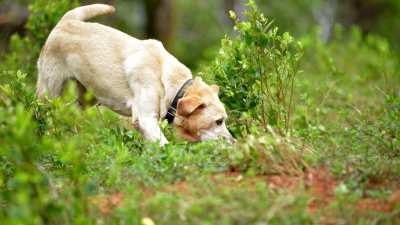
Cooper eventually needed emergency surgery on his digestive system. His treatment has cost the family more than £6,000 (about $8,000), including surgery, medicine and specially formulated food. He is recovering but will need a specially adapted diet for the rest of his life.
Are There Any Efforts to Require Warning Labels on Plants Toxic to Dogs?
Roberts started a Change.org petition on May 26 asking the UK government to require toxicity warnings on plants sold by shops, garden centers and other suppliers. The petition calls for labels that clearly state whether a plant is toxic to cats or dogs and include the telephone number for Animal PoisonLine. More than 580 people have signed it as of July 14.
“It’s such an easy fix. I’m not asking for a million pounds to change the world,” Roberts told the BBC. “I’m just asking for a little bit of writing on a label upon purchase to save our little fur babies.”
Why Do Some Experts Think Labelling Change Is Possible?
Gurdip Singh, CEO of labelling software company Kallik, called the petition a “fabulous” idea in an interview with the BBC. He argued that the infrastructure already exists.
“In terms of feasibility [it’s] very doable. Companies around the world work to strict regulations [and] have systems in place,” he told the outlet. “This is just about putting further information onto the label to enable the consumer to be better informed.”
Why Don’t Warning Labels on Toxic Plants for Dogs Already Exist?
Not everyone believes labelling reform is on the horizon. In an online Q&A, personal injury attorney Stephen Hoffman was asked why there aren’t labels warning consumers about plants that are toxic to pets.
“Unfortunately, it is up to us to safeguard our pets in the household,” Hoffman replied, adding that pet owners are expected to know what’s toxic and the government doesn’t require the label.
What Are the Most Common Toxic Plants for Dogs?
The ASPCA’s database lists 416 plants that are toxic to dogs and 428 that are toxic to cats. Many of them are species you’d find in a typical garden.
Azaleas topped the ASPCA’s list as the most popular toxic plant for dogs in 2025, according to the Quad-City Times.
Hostas, a common houseplant also known as plantain lilies or funkia, were recently linked to a Chihuahua’s near-death in England. They contain a compound called saponins that the ASPCA lists as toxic to both dogs and cats.
Tulips are another widely grown plant that poses a threat. They contain a chemical called Tulipalin A and B, which the ASPCA says is toxic to dogs and cats. The bulb is the most dangerous part.
Carolina jessamine, a decorative vine found in landscaping, has also been linked to a dog’s death in Washington, D.C.
What Symptoms Do Plants Poisonous to Dogs Cause?
Symptoms vary depending on the plant, but many plants poisonous to dogs attack the digestive system.
Saponins, the toxin found in hostas, cause burning in the mouth, salivation, vomiting, diarrhea, irritation and cough, according to a 2023 scientific review published in the journal Toxins. In some cases, fatigue and difficulty breathing can follow.
Tulips can cause vomiting, depression, diarrhea and hypersalivation, especially when the bulb is ingested.

“I think we should be a bit more aware of what we have in the garden and what we have in the kitchen for our pets,” veterinarian Gabriel Wax, who treated Cooper, told the BBC.
What Happened to the Springer Spaniel at the Tulip Festival?
In April, dog owner Jemma Ladwitch lost her 3-year-old springer spaniel just three hours after visiting a tulip festival in England. The BBC reported that the dog fell ill shortly after the visit. Robert Copley, director of Farmer Copleys Tulip Festival, told the BBC there was clear guidance warning attendees about the risks.
The festival still chose to ban pets for the rest of the season. “As a precautionary measure, we have made the difficult decision to no longer permit dogs at our Tulip Festival for the remainder of the season,” the farm wrote in a Facebook post.
What Happened to Goose in Washington, D.C.?
Goose, a 2-year-old dog, died after eating Carolina jessamine in the courtyard of his apartment complex. The toxic vine, one of many plants hazardous to dogs, was removed about a week later, but residents criticized the building’s response.



They launched a petition, now signed by more than 1,150 people, calling for Carolina jessamine to be banned from shared-use landscaping across the city.
How Can I Make My Garden Dog-Friendly?
Until labelling laws change, it’s up to pet owners to audit their own gardens and homes. The simplest starting point is the ASPCA’s list of toxic plants for dogs, which covers 416 species. It also lists 428 plants that are toxic to cats.
Choosing dog-friendly plants when landscaping is one of the easiest ways to reduce risk. If you already have an established garden, cross-reference what’s growing against the ASPCA’s database before letting your pet roam unsupervised. A few minutes of research could prevent a costly and potentially fatal emergency.